Showing posts with label ★WIPSTUDY. Show all posts

2.20.2023

Protect our table, Agritech


Due to severe climate change, conflicts between countries, and declining crop yields, the world's food crisis is getting worse and worse. A situation is coming where we can no longer keep our tables on traditional farming methods. In this issue, from this perspectives we’re going to look at ‘Agritech’, which will achieve agricultural innovation as a cutting-edge IT technology.

clipartkorea.co.kr

‘Agritech’ farming with AI and big data instead of a shovel,

Agritech, as a combination of Agriculture and Technology, refers to activities that agriculture meets cutting-edge IT technologies such as AI big data analysis to develop a series of technologies for agricultural innovation, from cultivation to production, distribution, and management. ‘Smart Farm’, which is familiar to us as a major technology leading Agri-Tech, literally refers to an intelligent agricultural system. Using smart farm technologies like IoT, big data, and AI, it can increase the efficiency and convenience of the entire process including cultivation, production, and distribution of crops.

Check the health of crops with deep learning,

The success of farming depends on the health of the crops grown. In particular, it is difficult for people to recognize the damages by diseases and pests of crops with the naked eye because the size and type are different. A Korean company has developed a system that can quickly identify the damages and accurately check health conditions through deep learning analysis.


wipsglobal.com/ KR10-2478723 B1
'Method and system for managing crops pets'

This technology monitors the real-time health status of crops based on the crop images input into the integrated system, analyzes the type and severity of damage, and predicts the spread of damages to neighbor farms when crops are affected by pests to help prevent in advance.

 From plant cultivation to barn management with IoT,

Recently, ‘indoor plant cultivator’ that can easily grow plants at home have been released and getting popular. It has been difficult to create a cultivation environment that reflects each variety and growth process of plants and to control the light source module. Korea's SK magic has developed a light source module and plant cultivation system for smart growers using IoT (Internet of Things) to improve this point.

wipsglobal.com/ KR10-2475601 B1
'Light source module for smart plant cultivation device,
smart plant cultivation device and smart plant cultivation system using internet-of-things 

In this technology, a light source module that automatically reflects and controls changes in natural light over time is mounted on a plant cultivator to set the intensity of illumination transmitted to each plant seed. Also the growth process of the plant being cultivated can also be transmitted to the user's mobile phone connected to the plant cultivator through IoT.

IoT can also help with disinfection and sterilization systems for livestock that are susceptible to viral infections. This technology can monitor the sensor measurement values of humidity, temperature, and odor from the inside video of the barn through the user's smartphone connected to the system using IoT, and it can remotely control the barn UV sterilization disinfection device.

wipsglobal.com/ KR10-2357974 B1
'System for sterilization and disinfection and infection prevention in pen using IoT
and method thereof'

Agricultural equipment is also in the era of self-driving,

Autonomous driving technology is no longer limited to the automotive industry. Now, we can meet tractors and robots that work on their own instead of people on farms and farmlands. The autonomous tractors and robots in rural areas where population aging and labor shortages are accelerating is welcome news like rain in a drought. John Deere, a global agricultural machinery & tractor manufacturing company, recently unveiled the fully autonomous tractor ‘8R’. It’s been reported that all autonomous driving is possible without driver, from sowing seeds to picking up the ground and driving.

Korean companies are also in the midst of developing autonomous tractors. TYM, a Korean agricultural machinery company, has developed autonomous tractor technology that can autonomously create a path and follow without driver intervention. It is said that the commercialization of autonomous tractors is already ahead and plans to be released soon.

wipsglobal.com/ KR10-1339750 B1
'Autonomous Tracktor'

Autonomous driving technology is also applied to agricultural robots. This technology is a self-driving system mounted on an eco-friendly weeding robot that automatically moves to the location where weeding is needed through camera sensors and GPS to perform weeding.

wipsglobal.com/ KR10-2389379 B1
'Autonomous driving system of weed removal robot'

Agritech, a protector for human food,

Now that the world is experiencing a serious food crisis, the problem of food for us and the next generation has already become a common problem that needs to be solved. Agritech may not be the best solution to solve this food crisis, which is entangled with complex elements, but if development and efforts to respond to the food crisis with IT technology are gathered, it may be the hope of new agricultural innovation.

clipartkorea.co.kr


12.21.2022

Is the sky originally blue?


I can't even remember the last time I felt emotions looking at the blue sky while walking on the streets without a mask. There may be a reason to wear a mask because of the new respiratory virus called Corona recently, but even before the corona, there were many things to wear a mask due to yellow dust and fine dust, so air purifiers and air conditioning facilities were important.

As mentioned earlier, fine dust literally means dust with very small particles. General fine dust is a small size of about 1/5 to 1/7 the diameter of a human hair, and stays in the air in an invisible state. Since fine dust is so small, there is a risk that it can directly penetrate organs such as the lungs through the respiratory tract or move into the body along the blood vessels, adversely affecting health.

In this issue, among the various technologies for resolving fine dust, we will look into the fine dust reduction technology and classify the removal technology in detail. In addition, we will check the recent research trends through the overall flow of patent trends by reduction technology.


       1. What is fine dust?

 Particulate Matter (PM) refers to very small dust particles that are invisible to the naked eye. Depending on their size, they are also divided into fine dust (10 μm or less, PM10) and ultra-fine dust (2.5 μm, PM2.5).

When exposed to fine dust for a long time, immunity is rapidly lowered, which can expand to various diseases such as cardiovascular diseases and skin diseases as well as respiratory diseases such as colds/asthma/bronchitis. According to recent research trends, as a result of analyzing the substances contained in fine dust, it is becoming a bigger problem due to the high content of heavy metals. This is because there is a high risk of expanding to problems in the human body caused by heavy metals in addition to problems caused by fine dust.


2. Fine dust emission sources and reduction technology

 ⬤ Causes of Fine Dust Emissions

 Air pollutants are classified into primary pollutants directly discharged from emission sources and secondary pollutants produced through chemical reactions in the air after other precursors are discharged. Air pollutant emissions can be calculated for primary pollutants, but direct emissions cannot be calculated for secondary pollutants. Therefore, fine dust also includes primary fine dust and secondary fine dust depending on the generation process. 

 A large amount of primary fine dust is emitted in the form of dust from chimneys of fuel combustion facilities, car exhaust vents, and windblown dust. Secondary fine dust includes aerosols such as ammonium nitrate or ammonium sulfate, which are produced through chemical reactions of sulfur oxides, nitrogen oxides, and ammonia already emitted in the air, and organic substances that have been condensed in the air. Looking at the fine dust analysis results measured in Seoul, it seems that about 20-40% of PM10 is composed of secondary fine dust. If the cause or solution to the primary fine dust emission is specifically and accurately analyzed, it is judged that it can be a key to solving the problem of fine dust.

 ⬤ Fine dust reduction technology

     Electrostatic Precipitator

The Electrostatic precipitator is a device that forms an appropriate unequal electric field using direct current high voltage and charges the dust in the gas using corona discharge in the electric field to separate and collect the charged corpuscle in the collecting electrode by the force of Coulomb.

            Hybrid Precipitator

   The Hybrid Precipitator technology is that maximize the increase in dust particle collection performance through a technology combination of conventional electric dust collection and filtered dust collection.

            Bag Filter

A filter is a filtering body for removing small solids in a gaseous phase or a liquid phase. A fabric filter, which is mainly used to control fine dust, is a very effective technology for separating particulate pollutants from combustion gas. The collection principle of a single fiber for this technology is operated by the mechanism of inertia, blocking, diffusion, and gravity in a filter.

        Diesel Particulate Filter (DPF)

DPF consists of a device that collects fine dust from the exhaust from diesel engines and a device that burns the collected dust.

   3. Fine dust reduction technology and patent trend by emission source

<fine dust reduction technology and detailed classification of emission sources>


  ⬤ Application trends by year/country

Application trends by country and all years
(The gray shaded area is an unpulished period)

 The trend of repeating the trend of increase → decrease → increase → decrease in the number of applications is observed, and it seems that about 300 applications are being filed steadily. In particular, applications from Korea and China show a continuous upward trend (↗), and especially in the late 2010s, the rising trend of applications from Korea is confirmed.

It is inferred that the trend of application by country reflects the result of investment and demand according to the changing policy of each country or air quality (fine dust, NOx, SOx, etc.).

 Application trends by all applicants

Top10 applicants related to fine dust reduction

As a result of extracting the top 10 applicants related to fine dust reduction, the applicant with the largest number of applications is TOYOTA MOTOR (JP, 383 cases), followed by YANMAR (JP), ISUZU MOTOR (JP), TOPSOE HALDOR (DK ), KUBOTA (JP), and JOHNSON MATTHEY.

 Application trends by fine dust reduction technology

Application status by fine dust reduction technology


Application trend by year for fine dust reduction technology
(The gray shaded area is an unpulished period)

The characteristics of application  trends by fine dust reduction technology include DPF(R4) > scrubber, adsorption(R5) > Bag filter(R3) > electrostatic precipitator(R1). As for the electrostatic precipitator technology, dry electrostatic precipitator(R1-1) continues to increase over time, whereas wet electrostatic precipitator(R1-2) is declining overall. In addition, the DPF(R4), which accounted for the largest number of inventions, is declining at a very rapid rate.

  ⬤ Application trends by source of fine dust emission

Application status by fine dust emission source


Application status by fine dust emission source
(The gray shaded area is an unpublished period)

 As for the characteristics of the application trend by fine dust emission source, it is confirmed in the order of transporting sources (E3) > power generation, combustion (E1) > industrial sites (E2). This results is expected that because research and development on emission sources of transporting closely related to our lives was more frequent in R&D for the high application rate of DPF (R4) technology in Japan and the United States in the early 2010s and replacement time or costly large-scale facilities.

 4. Conclusion

Industry continues to develop, and consequently, more pollutants are emitted. It is impossible to recover the pollutants already discharged or restore the destroyed environment by blaming only the problem of technological development or lack of awareness or policy for these emission factors.

Therefore, rather than not taking reduction technologies and regulations because of the immediate cost or time required, it should be resolved through thorough cause analysis and related research and development.

 In addition, it seems necessary to respond jointly through the establishment of infrastructure such as cooperation with the government and corporations, and institutional incentives and support for the introduction of reduction technologies.


Reference

- Current Status and Problems of Fine Dust Pollution (Jang Young-ki, 2016)

- Characteristics of air pollutants and prevention facilities (instrumentation technology, 2009)

- Fine dust treatment principle and technology development trend (National Land No. 452, 2019)

- Management plan for prior pollution reduction in air emission facilities (Korea Environmental Institute, 1998)


 😄Report by JunKyu PARK, powe0519@wips.co.kr

IP Strategy 3 Team l Manager

JunKyu PARK specializes in patent trend analysis and patent big data processing using AI, focusing on major industries such as displays, batteries and polymers.


10.06.2022

How are your muscles?


  Aging, which means the gradual deterioration of the structure and function of the body with age, is irresistible. In other words, a Korean saying that ‘We can’t fight against age’, the issue of aging, which approaches equally to all, may be the subject that is receiving the most attention now that we have recently become economically and socially prosperous.

  As mentioned above, due to aging, various organs of the human body, such as organs, muscles, and bones, become weak or incapacitated like an aging automobile. Among them, the decrease in the amount and function of muscles used most for moving or living affects the quality of life of the elderly. In severe cases, it can lead to secondary damage (fall, collapse, difficulty in moving, etc.), which is very serious. The disease caused by this decrease in muscle mass and function is called 'Sarcopenia', and recently the WHO recognized it as a disease and gave it a disease code.

  In this plan, we want to check the recent research trends through the overall flow of patent trends for food and medicines development for treatment, along with specific details on Sarcopenia among various problems caused by aging.


1. What is Sarcopenia?

  Sarcopenia refers to a disease in which muscle mass, muscle strength, and muscle function all decrease with increasing age. The causes of Sarcopenia vary from person to person. The most common causes are low protein intake and lack of exercise, but in particular, the rate of Sarcopenia caused by insufficient intake and absorption of essential amino acids is very high. Another cause is the lack of hormones associated with aging.

  In addition, Sarcopenia not only for the muscle itself, but also frequently occurs secondary to acute chronic diseases such as diabetes, infectious diseases and cancer, to degenerative diseases such as spinal stenosis. Sarcopenia is known to occur at a high frequency even when chronic diseases of the heart, lungs, kidneys, and hormonal diseases, so it is a recent issue as a disease related to aging.

2. Sarcopenia prevention and solution

   ◎ Healthy eating habits

  The first is a balanced diet, the second is sufficient protein. According to the Korean Nutrition Society, divide into 5 food groups- grains (carbohydrates), meat, fish, eggs, legumes (protein), vegetables (vitamins, minerals, dietary fiber), fruits (vitamins, minerals, dietary fiber, sugar), and milk/dairy products(calcium), and recommend that grains 2-4 times a day, meat, fish, eggs, and legumes 3-4 times a day, vegetables 2 times a day, fruits 1-2 times a day, milk and dairy products 1-2 times a day. Older people need more protein because their ability to synthesize them into muscle decreases, even if they take the same amount of protein.

  Regular exercise

  It has been reported through many studies that regular exercise is effective in improving physical function, enhancing immunity and preventing aging. However, increasing the intensity of exercise recklessly can bring side effects or adverse effects. Therefore, it is important to choose an effective exercise that suits your fitness level. In addition, it would be even better if you could do a customized exercise that determines the amount and intensity of exercise depending on your physical strength and condition during exercise.

 3. Patent trend of food and mediciness to prevent Sarcopenia

<Detailed classification of food and medicines for preventing Sarcopenia>


   ◎ Application trends by year / country

▲ Application trends by year


 Trend of applications by section / country

  As we can see the graph from the filing trend by year, overall, it shows a continuous upward trend (↗). It is observed that the filing activity by country is also active in general. However, recently (as of the late 2010s), the increase in applications in Korea and the United States is relatively high compared to other countries.

   ◎ Application Trends by All Applicants

 Top applicants for foods and medicines to prevent Sarcopenia

 The status of the top applicants for foods and medicines to prevent Sarcopenia

  As a result of extracting the top applicants, the applicant with the largest number of applications is Yonsei University Industry-University Cooperation Foundation (KR), followed by BRISTOL MYERS SQUIBB CO (US), WYETH LLC (US), NESTLE (CH), etc.

   ◎ Application trends for foods and medicines to prevent Sarcopenia by use

                                                  ▲ Status of application counts by year / use

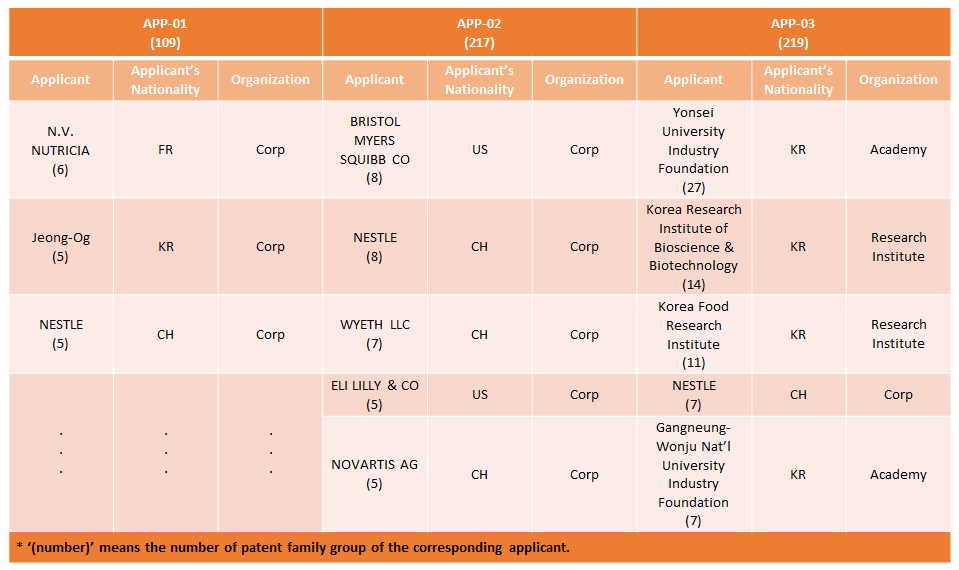
                                                            ▲ Top Applicants by Application

  The use of technologies related to Sarcopenia and muscle strength improvement is confirmed in the order of food, medicines (APP-03) > medicines (APP-02) > food (APP-01). And uses of both APP-01 and APP-03 are showing an increasing trend when the number of application groups is listed in time sequentially.

  In addition, in the case of APP-03 use, it is recognized that most of the top applicants are applicants of Korean nationality. As it’s confirmed that a large number of applicants in the form of schools and research institutes are included in the upper-level applicant group, technology seems in the development stage.

   ◎ Application trends by material for food and medicine to prevent Sarcopenia

 Status of application by year / material (MAT-01, 02, 06)

▲ Top applicants by material (MAT-01, 02, 06)

  As materials for Sarcopenia and muscle improvement-related technologies, extracts (MAT-01) > compounds (MAT-02) > amino acids (MAT-06) are identified in the order. Based on MAT-01, MAT-02, MAT-06, they’re seen that active research is in progress with an increasing trend when the number of application groups is listed in time series,

  As for MAT-01, it’s recognized that most of the top applicants are researchers and school type of applicants, whereas the applicants of MAT-02 and MAT-06 in the upper level are the mostly corporation type.


  Along with the rapid aging of the population, the anti-aging market is growing significantly and remarkably as time goes by. However, for Sarcopenia, there has not been a clear development in relation to the essential preventive methods and treatments.

  Only recently, Sarcopenia has been drawing attention, and research for prevention and treatment has been active, but there is no commercial product developed in the form of medicine or food in reality. Therefore, it is expected that continuous investment and R&D in related fields will be required. It will need to narrow the technological gap through patent monitoring of advanced countries and companies with excellent biotechnology.


 ------------------------------------------------------------------------------------------------------------------------------

  References

- Muscle loss with age, Sarcopenia, is a disease. (2021, Seoul National University Bundang Hospital)

- How to prevent ‘Sarcopenia’, which is a decrease in muscle mass? (Korea Policy Briefing 2021)

- Current status and prospect of anti-aging treatment and service market (Biotechnology Policy Research Center, 2020)

- Development of original technology for controlling aging muscle loss (Korea Research Institute of Bioscience and Biotechnology, 2014)


😄Report by JunKyu PARK, powe0519@wips.co.kr

IP Strategy 3 Team l Manager

JunKyu PARK specializes in patent trend analysis and patent big data processing using AI, focusing on major industries such as displays, batteries and polymers.


8.16.2022

Silent intruder, Nitrogen Oxide


   As energy consumption increases, air pollution caused by gases emitted during the combustion of fossil fuels is becoming a serious social issue. Representative pollutants are nitrogen oxides (NOx), sulfur oxides (SOx), carbon monoxide (CO), and unburned hydrocarbons (HC). Nitrogen oxides are known to cause damage to the human body as a cause of photochemical smog, or to cause corrosion of buildings and acidification of soil and plants as a cause of acid rain.

In this issue, we’d like to confirm the direction and current position of nitrogen oxide reduction technology through the overall flow of the technological content and patent trend of nitrogen oxide pre/post treatment technology, as well as cases and solutions by source of nitrogen oxide pollution.


1. Nitrogen oxide and damage

  There exist stable N2O, NO, N2O3, NO2, N2O5 and unstable NO3 in nitrogen oxides, and those that exist enough to cause problems in the air environment are NO and NO2, and these substances are usually called nitrogen oxides (NOx) in terms of air pollution. Representative examples of damage include acidification of soil, plants and crops caused by acid rain, photochemical smog, and diseases caused by fine dust inhaled through respiratory tract, and the damage is increasing day by day.


2. Major Nitrogen Oxide Reduction Pre/Post Treatment Technology

  Among the pre- and post-treatment technologies for reducing nitrogen oxides, two of the most representative technologies were selected, so we introduce here briefly.

  ① Low NOx Burner (LNB)

  A method that reduces the combustion intensity by controlling the mixed characteristics of fuel and air, and controls the flame temperature and oxygen concentration in the initial combustion region to suppress the generation of thermal NOx and fuel NOx.

  ② Exhaust Gas Recirculation (EGR)

  A technology that lowers the combustion chamber temperature by recirculating a portion of the exhaust gas burned in the engine back to the engine, thereby suppressing NOx emission.


Post-treatment technology to reduce nitrogen oxides

     A. Selective Catalytic Reduction (SCR)

  As a technology for converting harmless N2 and H2O using ammonia as a reducer, is the most representative technology for reducing NOx among the technologies developed so far because of its high denitrification efficiency and ease of operation and maintenance.

     B. Selective non-catalytic reduction (SNCR)

  It’s a way that a reducer containing nitrogen, such as ammonia and urea, is sprayed at a temperature of about 870 to 1150°C, and the sprayed reducer is ionized and reacts with nitrogen oxides in an oxygen environment to finally decompose into N2, CO2 and H2O.


3. Patent trend of nitrogen oxide reducing technology

                 <▼Detailed classification of nitrogen oxide reducing technology>


Application trends by year / country

Trends in the number of applications by year / country

Trends in the number of application counties by year based on main category

  A tendency to repeat the trend of increase → decrease → increase is observed, and the results of applications in Korea and China show a continuous upward trend (↗). In addition, it is observed that post-processing technology is concentrated in an absolute ratio compared to pre-processing technology, and the market is also expected to be ubiquitous.

Application Trends by All Applicants


▲ All Top Applicants

Top Applicant's Nitrogen Oxide Reduction Pre/Post processing Technology Status


The applicant with the largest number of applications is TOYOTA MOTOR, followed by Hyundai Motor Co., Ltd., HSD Engine Co., Ltd., and GM GLOBALTECHNOLOGY OPERATIONS in that order. It tends to focus on post-processing technology.

NOx reduction pre-processing technology application trend

Application Trends by Nitrogen Oxide Reduction Pre-processing Technology

Top applicant for nitrogen oxide reduction pre-processing technology

  Among the nitrogen oxide reduction technologies, the pre-processing technology is confirmed in the order of exhaust gas recirculation (A4) > low NOx burner (A6) > water (or steam) addition (A10), etc.

 Top applicants related to pre-processing technology among nitrogen oxide reduction technologies were confirmed in the order of UNIV SHANGHAI JIAOTONG (CN), 上海之邦科技股有限公司 (Shanghai Huazhibang Technology)  (CN), Daewoo Shipbuilding & Marine Engineering (KR), Korea Institute of Industrial Technology (KR).

  In addition, out of a total of 389 nitrogen oxide pre-processing technologies are concentrated in A4 (about 39%) and A6 (about 38%) subcategories, and it is judged that the result is due to the reduction efficiency as a characteristic of this technical field. .

  NOx reduction post-processing technology application trend

Application Trends by Nitrogen Oxide Reduction Post Treatment Technology


Top applicant for nitrogen oxide reduction post-processing technology

  Among the nitrogen oxide reduction technologies, post-processing technologies are confirmed in the order of selective catalytic reduction (B1) > using other catalysts (B2) > selective non-catalytic reduction (B3) > wet processing (B4), etc.

  Top applicants are listed in the order of TOYOTA MOTOR, HSD Engine and Hyundai Motor.

  Among a total of 2,882 post-processing technologies, patent filing was focused on B1 (about 63%) sub-class, and it is inferred that demand and applications are active because its high efficiency is good enough for international environmental regulations.


   The nitrogen oxide problem is directly related to our industrial activities, and it is a pollutant that has a very high cost in strengthening regulations and applying abatement technology to prevent it. Therefore, basic data such as recent domestic and overseas development of NOx reduction technology and cost analysis for each application are closely required. In addition, policy preparation is also required to be carried out concurrently through changes in social beliefs and related legislation.


 ------------------------------------------------------------------------------------------------

References

- Automotive fine dust and nitrogen oxide reduction technology and market trends (2016, KEITI)

- Catalytic chemistry technology for reducing nitrogen oxides, a mobile pollutant (2020, New Material Economy)

- Status of denitrification technology for power generation facilities (2009, instrumentation technology)

- Trend of nitrogen oxide reduction technology in cement industry (2020, resource recycling)

- Ultra-low NOx burner (2016, KISTI Market Report)

- Technology trend of Hybrid SNCR/SCR (2006, Connectic Report)

- 2020 vision and strategy for high-performance environmental equipment (2007, KIET)


😄Report by JunKyu PARK, powe0519@wips.co.kr

IP Strategy 3 Team l Manager

JunKyu PARK specializes in patent trend analysis and patent big data processing using AI, focusing on major industries such as displays, batteries and polymers.